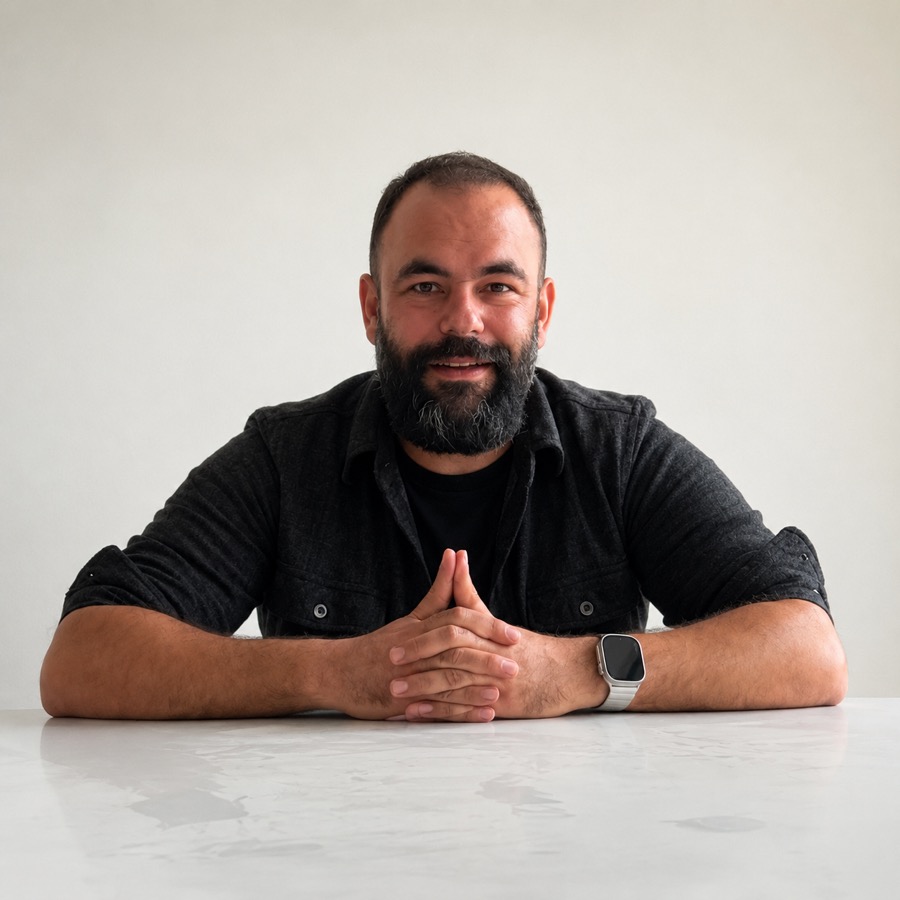
Founder · Backyard Brew
RYAN KHALIL
$15,000 and a cart. No investors. No shortcuts.
"If you cannot find the light, you must become the light."
Scroll
$15,000 and a cart. No investors. No shortcuts.
"If you cannot find the light, you must become the light."
Ryan is the youngest of three brothers in an immigrant family — a German mother and a Palestinian father. Two heritages the world so often casts as opposites; he has spent his life proving they can live as one. He grew up under more than one faith, learning to see the world through more than one window — and came away certain that most of the walls between people are built of nothing but misunderstanding. His parents came to America with little and built the American dream by hand. From one side he took German engineering — precision, systems, excellence. From the other, Arab hospitality — generosity, warmth, welcome. Not cultural footnotes. The operating system for everything he builds.
The entrepreneur showed up early: lemonade at eight, building computers at eleven, a middle-school pizza arbitrage — whole pies delivered to the back of the school and sold just under the cafeteria's price. In high school he fixed cars, built skateboards and computers, and swung at venture after venture — sign-making, garments, screen printing, websites, networking, security systems, catering, wedding photography. He failed fourteen businesses before one finally worked. Every one was tuition.
"We come into this world with nothing, and we leave with nothing. What matters is the character and the principles you live by."
In the fall of 2016, a few months before my first son was born, I spent fifteen thousand dollars on a coffee cart in Palo Alto — the heart of Silicon Valley, the one place on earth where nobody starts anything without a pitch deck.
I didn't have a pitch deck. I had a cart. In its first two months, it earned six hundred and seventy-seven dollars.
While the Valley around me announced funding rounds, we just opened the door. No investors — I never took any. No debt — I refused to borrow. No press. Just one loop I was willing to run forever:
Experiment. Fail. Learn. Adjust. Repeat.
The cart became a café — the hidden café, tucked off California Avenue, found by the people who needed it. And they came: the founders, the engineers, the students, the dreamers. The loudest industry on earth came to our little room to be quiet, to talk like humans, to be somebody. Hidden in plain sight, we became a silent mover in Silicon Valley — zero venture capital in the capital of venture capital, growing the old way: one cup at a time.
$141K the first full year. Then $229K. Then $471K. A pandemic emptied the Valley and we bent twenty-five percent — but we didn't break, and the next year was our best ever. By 2024 that crazy little concept was doing $1.18 million a year, serving almost three hundred people a day. We roasted our own coffee. We blended our own tea. We built recipes from real spices and herbs instead of pumping syrup from someone else's catalog. Some experiments lived a season and died quietly. I kept the receipts. That's the loop, too.
Then, at its peak, the city stopped us. Compliance. Code. The building had to be brought up to standard, and there would be no serving another cup until it was. I won't dress that up as strategy — it was a punch. But the loop doesn't care how the failure arrives. So we made a choice inside the thing we didn't choose: if we had to tear into the building anyway, we wouldn't patch it — we'd rebuild it into the store it was always meant to become. The city paused us. The flagship is our answer.
Six years to the day after that first cart — October 31 to October 31 — Backyard Brew planted its second flag in Charlotte, North Carolina. Two coasts, twenty-eight hundred miles apart, the same soul in both rooms. Somewhere along the way we passed seven hundred thousand orders — seven hundred thousand small moments where someone walked in carrying their day and left a little lighter.
It was never really about coffee. It's about the third place — not home, not work, the room in between where you're allowed to be somebody. That's why our walls are for painting on. That's why we know your name. We serve to survive. I mean that in every direction the sentence can go.
I'm the son of Abraham Khalil and the father of three boys. Everything I build lives somewhere on the line between those two facts. I wake before four without an alarm, build until late afternoon, and give my evenings to my family — because a man who builds a gathering place for strangers and misses his own table has learned nothing.
Ten years. Fifteen thousand dollars. No investors, no debt, no shortcuts. And we're just getting started.
Still running the loop.
Ask Ryan what he does and he'll dodge the label. "A jack of all trades and a master of none — which is far better than a master of one." Coffee, software, writing, music: to him they aren't different careers. They're different expressions of one purpose.
Press him to name that purpose in a single word and it's compassion. He'll tell you the world's biggest problem isn't intelligence or money or politics — it's miscommunication, and underneath it, a shortage of compassion. Everything he builds is an attempt to close that gap.
Backyard Brew, Brew OS, Critical Café, the writing as R. Solace, the music, the AI systems — from the outside they look like scattered ventures. They're one mission wearing different clothes: an ecosystem that helps people feel more connected — to themselves, to each other, to their communities.
Coffee creates conversations.
Conversations build understanding.
Understanding fosters compassion.
Compassion strengthens communities.
He thinks in decades, not weeks — building principles and systems meant to outlive him, so the why survives long after the founder does.
R. Solace
Out of the hardest years, he chose to become the light — and started writing it down, for the world and for his boys.
R. Solace is the pen name Ryan created from the toughest chapter of his life (2023 to now) — lessons written first for his three boys, Adam, Abbi, and Ayden, and shared with the world. Many begin the same way: "My boys…" Some live as "A Backyard Brew Story."